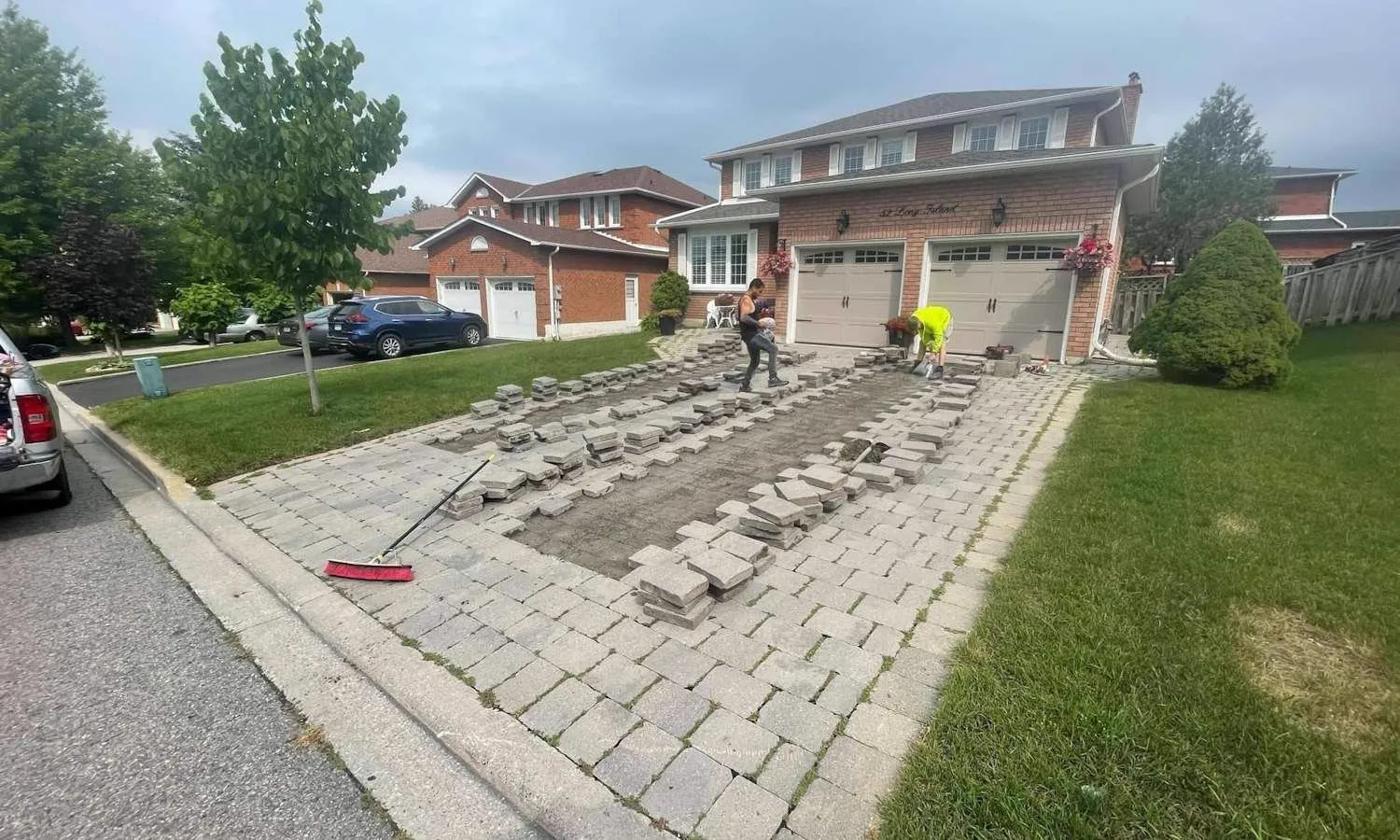
Nearly every sunken driveway we get called to has the same three causes, and the pavers themselves are never one of them.
We look at a lot of driveways that have gone wrong. Almost all of them fall into three buckets, and in none of them is the paver at fault. Concrete pavers are enormously durable; what fails is what somebody did or did not do underneath.
1. The base was never deep enough
A driveway carries vehicles. A walkway carries people. The base depth is not the same, and the single most common mistake is building a driveway to walkway standards because it looked fine when the crew drove away.
You see it first at the apron, where the driveway meets the garage slab or the sidewalk. A rut forms in the wheel track, or the whole apron drops an inch and water starts pooling against the garage. That is a loading failure, and it is a base depth problem every time.
2. It was compacted in one go
Gravel has to be compacted in layers. Dump six inches in and run a compactor over it and the top three inches get dense while the bottom three stay loose. It passes any test you can do by eye. Then a winter of moisture and a summer of vehicles find the loose part.
Compacting in lifts is slow, boring, and the least glamorous line item on any quote. It is also the difference between a driveway that lasts twenty years and one that lasts five.
3. Water had nowhere to go
This is the Edmonton-specific one. If water gets into the base and cannot leave, it freezes. Frozen water takes up more room than liquid water, so the ground lifts. Then it melts and drops. Do that a few dozen times over a few winters and the surface no longer sits where it started.
The fix is not complicated: open-graded stone that stays porous, a deliberate slope so water heads somewhere, and no fabric wrapped around the base like a bathtub liner. We do it on every job.
So what does the repair look like?
In most cases the pavers get lifted, stacked in order, and put back. That surprises people who assumed they were up for a full replacement. The stones are usually the healthiest part of the whole assembly.
What changes is everything below: soft material out, proper depth restored, gravel back in and compacted in layers, and the grade re-set so water leaves. Then the same stones go back down to one plane with fresh polymeric sand in the joints.
One warning about partial fixes
If only the visibly bad section gets corrected, the rest of the driveway carries on settling to its own schedule. Six months later there is a new low spot two metres away, and you are chasing the problem across your own driveway. When the whole surface is moving, resetting the whole surface at once is the cheaper decision in the end.